Maybe I’ve been reading too much Money Stuff newsletter but I’ve been thinking about the potential untended consequences of agentic commerce on hotel reservation systems. There’s a theoretical dream scenario in mind by the hotel brands meeting the consumers where they want to be, namely in their generative agent window. Instead of the guest hunting-and-pecking for rates and availability for a trip on multiple sites (both direct and OTA) they simply pop open their generative application of choice and say “Book me a trip to so-and-so place on this-and-that dates.” This is a weird fetish us folks in the hospitality industry have, that if only you could just tell us what you want we’d actually, like, you know, give it to you. You want to come to Las Vegas for Fourth of July Weekend? Great. Tell me, and I can start telling you what it’ll cost you.
One of the interesting questions though is once you’ve got an agent, what might that do to change your behaviors? A real agent – not a clumsy & overly compliant helper bot. An agent that can start to think about the hotel industry’s incentives, such as our desire to earn a guest’s booking based on a bit of convenience and cashflow trading. Many hotels today use various price points to incentivize guests to commit to the stay through various cancellation policies. Here’s an example from a random look at Hilton:
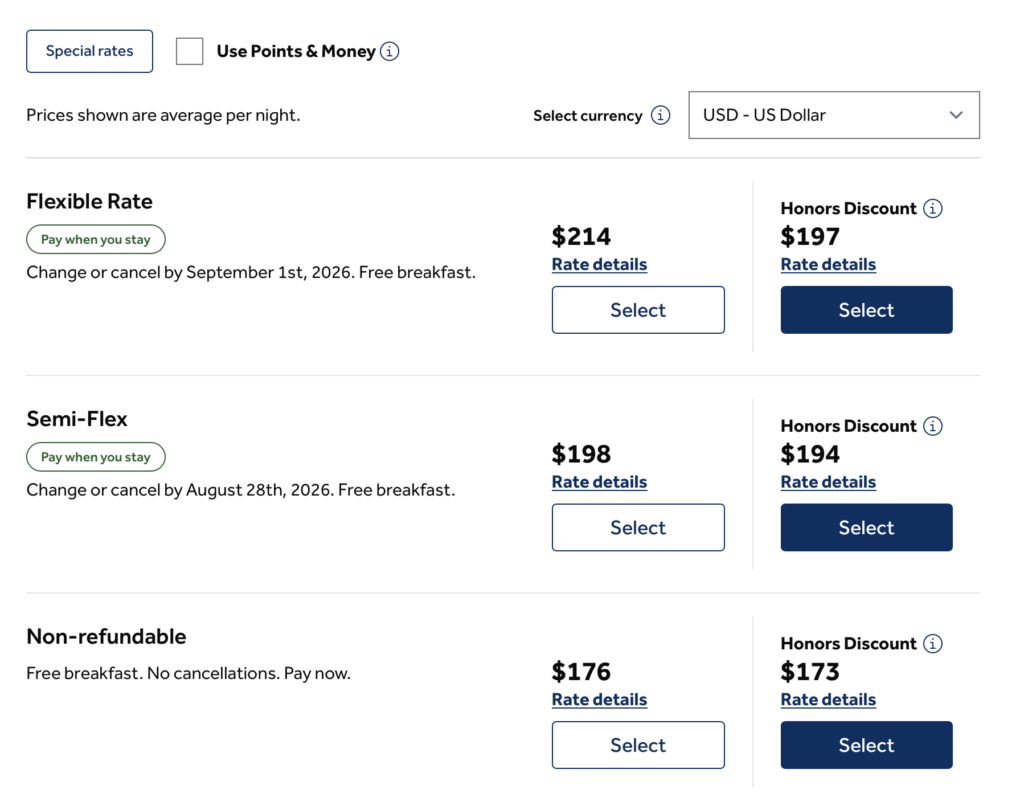
As you can see, the most flexible rate is ~18% more expensive than the non-refundable rate (less lucrative for Hilton Honors members but that’s a different discussion). So clearly the hotel has a strong incentive for you to choose the non-refundable rate – they’ll literally sponsor $38 for that cashflow today (and this is only looking at random dates 2 months out).
So here’s my thought experiment. In a world of agentic commerce where the agent theoretically has nothing to do but wait and nothing but infinite patience, what are some of the things it could do?
Well for one it could: “Book everything in the market and I’ll make my decision closer to arrival.” Consumers do this today on their own, but the friction of the booking engine and the assumption that the user has some sort of time-value to their time prevents this from being too big of an issue. Of course many people may have a top-2 or top-3 selection set and they book these refundable rates because of this exact feature – they can choose their favorite closer to the arrival date, pay a little extra for the flexibility, and then cancel the one(s) they decide not to take.
But in an agentic world, there’s far less friction to filling up carts and executing multiple reservations across any number of brands in a market. Yes, a credit card deposit may be required making this a little less desirable but overall it’s a plausible action for an agent tasked with “get me a room somewhere” assignment that wants to lock in choices for its user. From a booking reservation engine point of view there’s a risk that as we enable agentic commerce and reduce the friction steps for agents to book reservations it becomes even easier for those agents to run this kind of game theory against cancellation policies.
You could even take this a step further if you wanted to mess with market dynamics a bit more. How many reservations would it take to saturate some markets? Las Vegas is a huge market – you probably couldn’t influence the availability of this market with a handful of reservations. But there may be some markets or opportunities where agents might spot a pricing disparity or could even create their own disparity with sufficient users and volume. Could you create artificial demand for a market by over-booking it, causing the price to increase (because the demand signals are now out of balance), and then once the price has moved up past your initial reservation rate could you sell the other reservation to a new user looking for that market at a discount?
The activity would look something like:
- Get a bot / agent to drive dozens-to-hundreds of cancellable reservations in a small market (let’s say at a $200/night rate)
- Push the visible pricing up to $220/night (+10%) – there’s no actual demand at this level, this is the artificial level
- Now if new users come to the market, can they offer the other reservation as a discount to the newly prevailing rate?
- Is there a way, once the friction is lowered and the agent has perfect memory and the ability to cancel everything intelligently, to arbitrage those prices either directly to the consumer or to the hotel itself?
Part of me wants to envision my agent brokering an exchange with the hotel’s agentic commerce system, “Hey, I’ll refund this nice king bed pool view I’ve got if you gimme $5 to get outta the deal!”
I’m not saying this is viable and there’s lots of terms & conditions in the agreement that gives the hotel lots of room to cancel these reservations anyways if it sees them coming. But on the other hand, once the friction of the actual booking flow is lowered low enough, there’s no reason this couldn’t be done. One thing I am certain of is the likelihood that cancellation policies and premiums will be heavily scrutinized as these engines start becoming available & easily traversable by agentic tools.